

Some muscle pain feels simple. You slept wrong. You lifted something awkwardly. You sat too long. You pushed too hard at the gym. But then there is the other kind of muscle pain. The kind that keeps coming back. The kind that feels like a deep knot under the skin. The kind that hurts in one spot but somehow sends pain somewhere else. The kind that does not fully go away with stretching, massage, heat, rest, or over-the-counter medication. That type of pain may be connected to trigger points.

Trigger Point Injections for Muscle Pain: Are They Worth It?
For patients with ongoing muscle pain, trigger point injections may be recommended as part of a pain management plan. But one question matters most:
Are trigger point injections worth it?
For the right patient, the answer may be yes. Trigger point injections can help relax painful muscle knots, reduce irritation, improve movement, and make it easier to participate in physical therapy or daily activity. They are not magic, and they are not the right answer for every type of pain, but they can be a valuable option when muscle pain becomes persistent and limiting.
At Center for Spine & Pain Medicine, with locations in Gainesville, GA, Dalton, GA, and Chattanooga, TN, our team helps patients understand whether trigger point injections may be appropriate for their symptoms and long-term pain goals.
What Are Trigger Points?
A trigger point is often described as a painful muscle knot.
But it is not just a regular tight muscle.
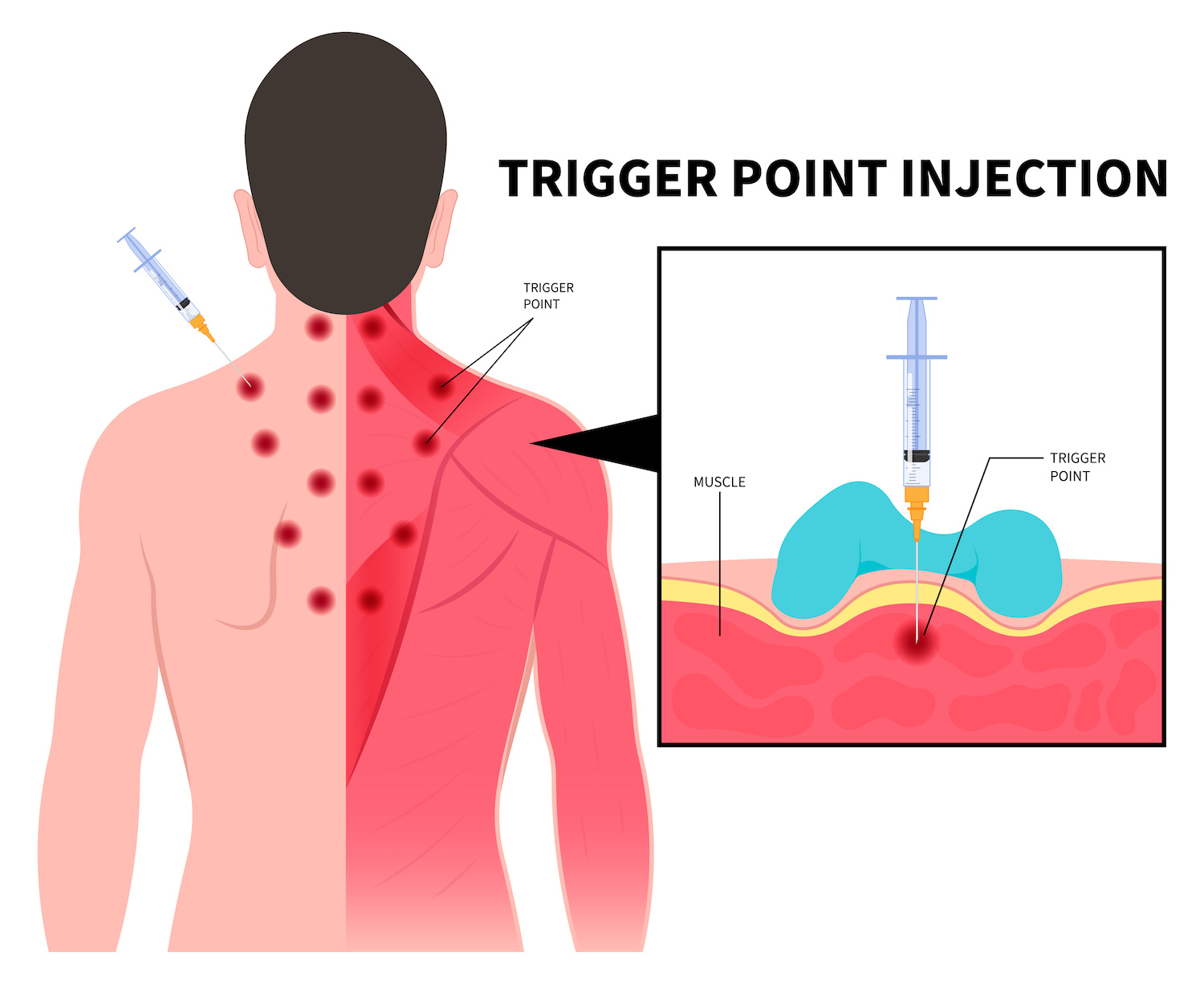
A trigger point is a sensitive, irritated area within a muscle that may feel tight, tender, or rope-like. When pressure is applied, it may cause pain right where the knot is located. It may also send pain to another area of the body. This is called referred pain.
For example:
A trigger point in the neck may contribute to headaches. A trigger point in the shoulder may send pain down the arm. A trigger point in the lower back may create pain around the hip or buttock.
What Are Trigger Point Injections?
A trigger point injection, also called a TPI, is a procedure where medication is injected directly into a painful trigger point.
The goal is to calm the irritated muscle area, reduce pain, and help the muscle relax.
The injection may contain:
- A local anesthetic, or numbing medicine
- Saline
- Sometimes a corticosteroid
- In select cases, other medication depending on the patient and provider’s recommendation
Trigger point injections as a treatment that may help relieve myofascial pain caused by muscle knots, and they are common and generally safe.
The procedure is usually quick and performed in an outpatient setting. Most patients go home the same day.
Are Trigger Point Injections Worth It?
Trigger point injections may be worth considering when muscle pain is no longer acting like ordinary soreness.
They may be helpful if you have:
- Muscle knots that keep returning
- Pain that does not improve enough with stretching or massage
- Neck, shoulder, upper back, or lower back muscle pain
- Pain that limits movement
- Pain that interferes with sleep
- Myofascial pain syndrome
- Muscle tightness after injury or repetitive strain
- Pain that makes physical therapy difficult
The value of trigger point injections is not only that they may reduce pain. It is that they may help “unlock” a muscle that has been stuck in a painful cycle.
Pain causes tension. Tension causes less movement. Less movement causes more stiffness. More stiffness causes more pain.
Trigger point injections may help interrupt that cycle.
What Does Trigger Point Pain Feel Like?
Trigger point pain can be different from regular muscle soreness.
Regular soreness often improves with time, rest, hydration, stretching, or light movement. Trigger point pain may linger or keep coming back.
Patients may describe it as:
- A deep knot
- A tight band in the muscle
- A tender spot that hurts when pressed
- Aching that spreads into another area
- Muscle stiffness that does not fully release
- Pain that worsens with stress or posture
- A burning, pulling, or heavy sensation
- Headache-like pain from neck or shoulder muscles
Some trigger points are active, meaning they hurt even when you are not touching them. Others are quiet until pressure is applied.
Either way, they can affect how you move, sit, sleep, work, and exercise.
Why Do Trigger Points Develop?
Trigger points can develop for many reasons. Sometimes there is one obvious cause. Other times, they build slowly over months or years.
Common contributors may include:
Poor Posture
Long hours at a desk, looking down at a phone, or working with rounded shoulders can overload certain muscles.
Repetitive Movement
Repeated lifting, reaching, bending, typing, or twisting can irritate muscles over time.
Injury
A fall, car accident, sports injury, or sudden strain may lead to painful muscle tightening.
Stress
Stress does not just live in the mind. Many people carry it in the neck, jaw, shoulders, and back.
Muscle Imbalance
When one group of muscles is weak, another group may overwork to compensate.
Lack of Movement
Sitting for long periods can reduce circulation and increase stiffness.
Chronic Pain Conditions
When pain has been present for a long time, muscles may tighten protectively around the painful area.
Trigger points are rarely just about one bad movement. They often come from a combination of tension, irritation, posture, inflammation, and movement habits.
How Do Trigger Point Injections Work?
Trigger point injections work by treating the irritated spot inside the muscle.
The needle itself may help mechanically disrupt the tight muscle fibers. The medication may reduce pain and help the muscle relax. This can improve blood flow, decrease local irritation, and allow the muscle to move more normally.
A simple way to think about it:
A trigger point injection helps reset a painful muscle knot so the body has a better chance to move, heal, and function.
What Happens During a Trigger Point Injection?
The process is usually simple and quick.
Step 1: Your Provider Finds the Trigger Point
Your pain specialist will examine the painful area and locate the tight, tender muscle band.
Step 2: The Skin Is Cleaned
The area is cleaned to reduce infection risk.
Step 3: A Small Needle Is Placed Into the Trigger Point
The needle is inserted into the painful muscle knot. You may feel a pinch, pressure, or a brief twitch.
Step 4: Medication Is Injected
The medication is delivered into the trigger point. Some patients feel immediate loosening. Others notice gradual improvement.
Step 5: You Return Home
Most patients can return home shortly after the procedure. Your provider may give instructions about activity, stretching, heat, ice, or follow-up care.
Do Trigger Point Injections Hurt?
Most patients tolerate trigger point injections well.
You may feel:
- A small pinch from the needle
- Pressure in the muscle
- A brief cramping or twitching sensation
- Temporary soreness after the injection
The soreness usually feels similar to post-workout tenderness or a bruise. For many patients, the discomfort is short-lived.
The important thing to remember is that trigger point injections are targeted. The injection goes directly into the painful muscle area rather than treating the whole body with medication.
How Soon Do Trigger Point Injections Work?
Some patients feel relief quickly, especially if a local anesthetic is used.
Others may notice improvement over several days as the muscle relaxes and irritation decreases.
A general timeline may look like this:
Same day: temporary soreness or early relief
24–72 hours: soreness may decrease
Several days later: movement may feel easier
1–2 weeks: benefit becomes clearer for some patients
Not every patient responds the same way. Some people need more than one session. Others may need trigger point injections combined with physical therapy, posture changes, stretching, or other treatments.
How Long Do Trigger Point Injections Last?
The length of relief can vary.
Some patients experience relief for days. Others may feel better for weeks or longer. The result depends on the cause of the trigger points, how long the pain has been present, your activity level, and whether the underlying contributors are also being addressed.
Trigger point injections may be most effective when they are part of a larger plan, not the only plan.
That plan may include:
- Physical therapy
- Stretching
- Strengthening
- Posture correction
- Ergonomic changes
- Stress management
- Better sleep habits
- Treatment of related spine or joint problems
The injection can help calm the painful area. The long-term goal is to keep the muscle from returning to the same painful pattern.
Trigger Point Injections vs. Massage
Massage can be helpful for muscle tension. It may improve circulation, reduce stiffness, and provide short-term relief.
But some trigger points are stubborn.
If massage helps temporarily but the pain keeps returning, trigger point injections may be considered. The injection reaches the irritated area more directly and may help calm the trigger point from within.
Massage works from the outside in. Trigger point injections work directly at the source of the muscle knot.
For many patients, the best approach is not one or the other. It may be both, along with movement retraining and strengthening.
Trigger Point Injections vs. Dry Needling
Trigger point injections and dry needling may sound similar because both involve placing a needle into a trigger point.
The difference is that trigger point injections usually include medication, while dry needling typically uses the needle without injecting medication.
Your provider can help determine which approach makes sense based on your symptoms, diagnosis, medical history, and treatment goals.
Trigger Point Injections vs. Steroid Injections
Not all injections are the same.
A trigger point injection treats a painful muscle knot. An epidural steroid injection may target inflammation around spinal nerves. A joint injection may treat inflammation inside a specific joint. A nerve block may help diagnose or treat nerve-related pain.
This is why an accurate diagnosis matters. If pain is coming from a muscle trigger point, a trigger point injection may help. If pain is coming from a disc, nerve compression, arthritis, or another source, a different treatment may be needed.
The right injection depends on the right pain generator.
What Areas Can Trigger Point Injections Treat?
Trigger point injections may be used in several muscle groups, including:
- Neck muscles
- Shoulder muscles
- Upper back muscles
- Mid-back muscles
- Lower back muscles
- Hip and buttock muscles
- Jaw-related muscles in select cases
- Muscles involved in certain headache patterns
Common examples include trigger points in the trapezius, levator scapulae, rhomboids, lumbar paraspinals, and gluteal muscles.
Patients often seek trigger point injections for:
- Neck pain
- Shoulder blade pain
- Tension-type headaches
- Upper back tightness
- Lower back muscle pain
- Muscle spasms
- Myofascial pain syndrome
Who May Be a Good Candidate?
You may be a good candidate for trigger point injections if:
- You have localized muscle pain
- Your provider can feel a tender trigger point
- Pain has not improved enough with conservative care
- Muscle tightness is limiting movement
- Pain is interfering with sleep or daily activity
- You need relief to better participate in physical therapy
- Your symptoms suggest myofascial pain
Trigger point injections may not be appropriate for everyone. Patients with certain infections, bleeding risks, medication concerns, allergies, or other medical conditions may need a different approach.
Are Trigger Point Injections Safe?
Trigger point injections are generally considered safe when performed by a trained medical professional, but every procedure has possible risks.
Potential side effects may include:
- Temporary soreness
- Bruising
- Minor bleeding
- Infection
- Allergic reaction
- Temporary numbness
- Lightheadedness
- Pain that does not improve
Rare complications can occur depending on the injection location. This is why it is important to have the procedure performed by an experienced provider who understands anatomy and pain conditions.
What Should You Do After Trigger Point Injections?
After the procedure, your provider may recommend specific instructions. In general, patients are often encouraged to keep the area gently moving.
Helpful recovery tips may include:
- Avoid strenuous activity for the rest of the day if advised
- Use ice or heat as recommended
- Drink water
- Stretch gently if approved
- Avoid aggressive massage immediately after injection unless instructed
- Pay attention to how your pain changes
- Follow up if symptoms return or worsen
Trigger point injections can create an opportunity. What you do after the injection can help protect the result.
When Trigger Point Injections May Not Be Enough
Trigger point injections can be very helpful, but they are not designed to solve every pain problem.
If muscle pain keeps returning, your provider may look for deeper reasons, such as:
- Spinal arthritis
- Herniated disc
- Nerve irritation
- Poor posture mechanics
- Weak core or stabilizing muscles
- Repetitive work strain
- Fibromyalgia
- Chronic inflammation
- Joint dysfunction
- Stress-related muscle guarding
Sometimes the trigger point is the symptom, not the original cause.
That is why a pain management evaluation can be valuable. The goal is not only to treat the knot. The goal is to understand why the knot keeps forming.
Are Trigger Point Injections Worth It for Chronic Muscle Pain?
They may be worth it if your muscle pain is persistent, specific, and limiting your life.
Trigger point injections may help when:
- Pain keeps returning to the same spot
- You can feel a tight knot in the muscle
- Stretching gives only temporary relief
- Massage helps but does not last
- Muscle pain is affecting sleep or activity
- Pain is preventing progress in physical therapy
They may be less helpful if:
- Pain is mainly from nerve compression
- Pain is caused by untreated joint damage
- The painful area is not muscular
- There is no clear trigger point
- The underlying cause is not addressed
The best results usually happen when trigger point injections are part of a complete treatment plan.
The Real Goal: Not Just Less Pain, But More Freedom
The real value of trigger point injections is not simply that the muscle hurts less.
It is what less pain may allow you to do.
Turn your neck more easily. Sit at work with less discomfort. Sleep without fighting the same tight spot. Walk without guarding your back. Return to physical therapy with less resistance. Feel like your body is not constantly bracing.
For many patients, that is what makes trigger point injections worth discussing.
Frequently Asked Questions About Trigger Point Injections
Are trigger point injections painful?
Most patients feel only a brief pinch, pressure, or muscle twitch during the injection. Some soreness afterward is common but usually temporary.
What medicine is used in trigger point injections?
Trigger point injections may use a local anesthetic, saline, sometimes a corticosteroid, or another medication depending on the patient’s condition and the provider’s recommendation.
How many trigger point injections will I need?
Some patients need one session. Others may need a series of treatments. Your provider will recommend a plan based on your pain pattern and response.
Can trigger point injections help neck and shoulder pain?
Yes, they may help when neck and shoulder pain is related to muscle trigger points or myofascial pain.
Can trigger point injections help lower back pain?
They may help if the lower back pain is muscular or related to trigger points. If the pain is caused by a disc, nerve, or joint problem, another treatment may be needed.
Can I go back to work after trigger point injections?
Many patients can return to normal light activity, but this depends on your job, symptoms, and your provider’s instructions.
Are trigger point injections a permanent fix?
Not always. They may reduce pain and muscle tightness, but long-term improvement often depends on addressing posture, movement patterns, strength, stress, and any underlying spine or joint issues.
Should You Consider Trigger Point Injections?
Muscle pain should not control your day, your sleep, your work, or your ability to move comfortably.
If you have painful muscle knots that keep returning, trigger point injections may be worth considering. They are targeted, generally quick, and may help reduce pain when conservative care has not been enough.
At Center for Spine & Pain Medicine, our team evaluates the source of your pain and helps create a treatment plan built around your condition, your function, and your goals.
Schedule an appointment with Center for Spine & Pain Medicine in Gainesville, GA, Dalton, GA, or Chattanooga, TN to find out whether trigger point injections may be right for your muscle pain.